
 Cosmic Solutions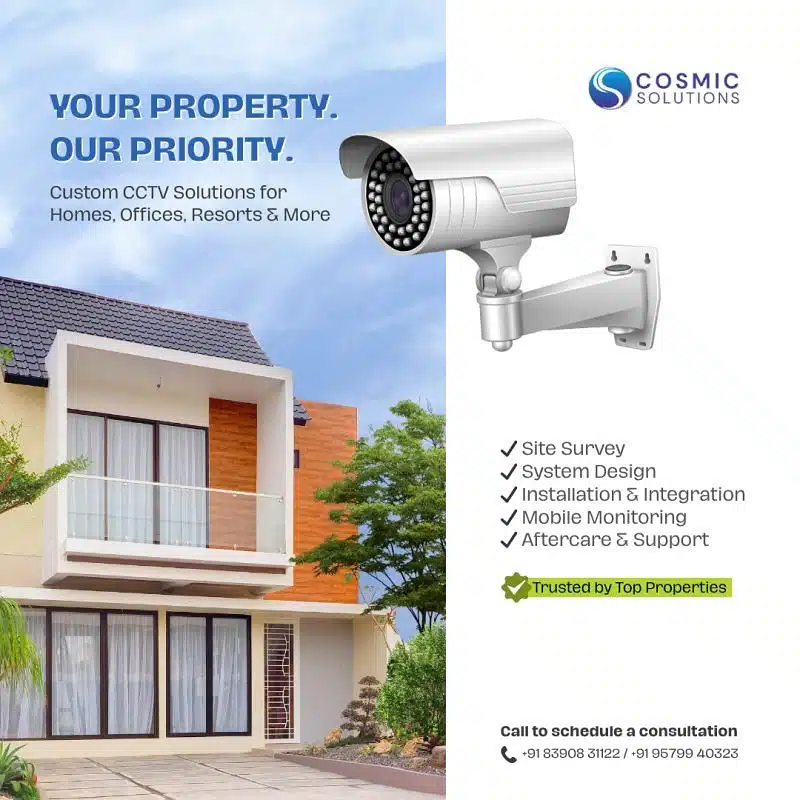
⚡ Key Takeaways
- CCTV cameras are no longer optional for Goa businesses — high tourist footfall, seasonal vulnerability, and insurance requirements make them essential.
- A small retail shop needs a minimum of 4 cameras; hotels and hospitality properties typically need 15–25+ for thorough coverage.
- Camera placement matters as much as camera count — the 8 critical spots every Goa business must cover are mapped out in this guide.
- Outdoor cameras in Goa must have a minimum IP65 rating — cheaper cameras corrode and fail within a monsoon season in coastal conditions.
- Pairing CCTV with biometric access control creates a complete security and accountability system that is far stronger than either alone.
It starts with a small incident. A shoplifting case that leaves you with no footage. A disagreement with an employee you can’t resolve because there’s no record. A break-in at your warehouse over the long weekend. A guest complaint at your hotel that your front desk team can’t verify.
For business owners across Goa — from Panaji’s commercial strips to Calangute’s resort belt, from Margao’s retail markets to Vasco’s industrial zones — CCTV cameras are no longer a luxury or a paranoid precaution. They are a basic, essential layer of business protection that most owners wish they had invested in sooner.
But the question isn’t just “should I get CCTV?” Most business owners already know the answer to that. The real questions are: How many cameras do I actually need? Where should I place them? What type of camera works best for my business? And how do I make sure the system is genuinely useful, not just a box-ticking exercise?
This guide answers all of it — specifically for business owners in Goa, where the combination of high tourist footfall, seasonal business patterns, and a mix of indoor and outdoor commercial spaces creates unique security requirements.
A CCTV system that isn’t properly planned, placed, and maintained doesn’t protect your business — it just gives you the illusion of protection. The difference lies entirely in how it’s done.
1. Why Every Business in Goa Needs CCTV in 2025
Goa’s business environment has specific characteristics that make security surveillance not just advisable but genuinely critical.
🏖️ High Tourist Footfall Creates Unique Risk
Goa welcomes millions of domestic and international tourists every year. Hospitality businesses, retail shops, restaurants, and activity providers deal with a constantly rotating, anonymous customer base. Unlike a neighbourhood store where you know most of your regulars, a Goa resort or beach-facing shop interacts with thousands of strangers every season. A CCTV camera for business in Goa creates a visual record that deters theft, resolves disputes, and protects both your business and your guests.
📅 Seasonal Business Patterns Create Vulnerability Windows
Many Goa businesses operate with reduced staff during the off-season. Skeleton crews mean fewer eyes on the ground, less oversight, and higher vulnerability to internal theft, vandalism, and break-ins. A well-planned CCTV system essentially gives you a surveillance team that never sleeps, never takes a holiday, and doesn’t need a salary.
⚖️ Insurance, Legal Protection & Dispute Resolution
CCTV footage is increasingly accepted as evidence in insurance claims, labour disputes, and legal proceedings. Businesses that have footage of incidents recover faster from insurance claims, resolve employee disputes with documented evidence, and protect themselves from false liability accusations. In Goa’s hospitality sector particularly, where guest disputes can quickly escalate, having camera coverage is invaluable.
🚨 The Deterrent Effect Is Enormous
Studies consistently show that the visible presence of CCTV cameras reduces opportunistic crime by up to 50%. For Goa businesses — especially those in tourist-heavy areas where petty theft, disturbances, and opportunistic crime are real concerns — cameras don’t just record incidents. They prevent them from happening in the first place.
2. How Many CCTV Cameras Does Your Business Actually Need?
This is the question every business owner asks first, and the honest answer is: it depends on your premises, your risk profile, and your budget. But here are practical starting points for the most common business types in Goa:
🛍️ Small Retail Shop or Restaurant (Under 1,000 sq ft)
Minimum 4 cameras: entrance/exit, cash counter or POS area, stock room entrance, and one wide-angle covering the main floor. This gives you coverage of the four highest-risk zones without overcomplicating the system.
🏢 Medium-Sized Office or Service Business (1,000–5,000 sq ft)
6–10 cameras: main entrance, reception, server room or IT area, accounts area, parking (if applicable), main corridor, and at least one camera covering the perimeter. Add cameras for any areas where cash or sensitive documents are handled.
🏨 Hotel, Resort, or Hospitality Property
This is where camera counts scale significantly. A boutique property needs cameras at the lobby, front desk, pool area, restaurant/bar, all corridor entry points, service areas, and parking. A property with 20+ rooms typically needs 15–25+ cameras for thorough coverage. The outdoor areas — gardens, pool decks, access points — require weatherproof cameras with night vision capability.
🏭 Warehouse, Godown, or Industrial Premises
Coverage priorities here are perimeter security, loading/unloading docks, internal aisles, server or control rooms, and all staff entry/exit points. A medium-sized warehouse typically needs 8–15 cameras depending on size and layout.
🏬 Retail Complex or Multi-Floor Commercial Space
Plan for cameras at every floor entry/exit, stairwells, elevators, cash points, and any blind spots in the layout. Multi-floor commercial spaces in Goa’s shopping areas like Panaji Market or Margao’s retail zones typically need 12–20+ cameras for complete coverage.
3. The 8 Most Important Camera Placement Spots for Goa Businesses
Where you place your cameras matters as much as how many you have. Here are the eight placements that every Goa business should prioritise:
1. 🚪 Main Entrance and Exit Points
Every person entering or leaving your premises should be captured clearly. Place cameras at a height of 8–10 feet, angled slightly downward to capture faces clearly. This is your most important placement — it identifies who was present at any given time.
2. 💰 Cash Counter and Point of Sale
The cash counter is the single highest-risk area in any retail or hospitality business. A dedicated camera here — ideally capturing both the staff and the customer side of the transaction — is non-negotiable. This protects you from both customer theft and internal discrepancies.
3. 🚗 Parking Areas
For hotels, restaurants, offices, and retail businesses with parking — this is often the most overlooked zone. Parking disputes, vehicle damage claims, and thefts in Goa’s busy commercial and tourist areas are common. License-plate-readable cameras at parking entry/exit points are particularly valuable.
4. 📦 Stock Room and Inventory Areas
Internal theft is statistically more common than external theft in most businesses. A camera covering the stock room entrance — not necessarily inside, to respect employee privacy — creates a strong deterrent and an audit trail for inventory discrepancies.
5. 🏗️ Building Perimeter and External Access Points
For businesses with outdoor spaces — especially relevant for Goa’s resort and villa properties — cameras covering boundary walls, garden access points, and back entrances are critical. These are the entry points most commonly used by opportunistic intruders after hours.
6. 🖥️ Server Room or IT Infrastructure Area
If your business has a server room, data storage area, or significant IT infrastructure, dedicated camera coverage of this space is essential. Unauthorised access to IT systems is a growing concern for businesses of all sizes.
7. 🏨 Common Areas and Corridors
For hotels and offices, corridors are where incidents between guests, customers, or employees most frequently occur. Wide-angle cameras covering long corridors from elevated positions provide coverage without requiring one camera per room.
8. 🚚 Loading and Delivery Areas
For businesses that receive regular stock deliveries, the loading bay or delivery entrance is a high-risk zone for theft, damage disputes, and unauthorised access. A camera here creates an unambiguous record of what was received, when, and by whom.
4. Types of CCTV Cameras — Which One is Right for You?
Not all CCTV camera for business in Goa options are equal. Here’s a plain-English breakdown of the main types and where each works best:
| Camera Type | How It Works | Best For |
|---|---|---|
| 🔵 Dome Cameras | Ceiling-mounted, discreet, wide viewing angle. Dome casing hides direction the camera faces — strong deterrent. | Retail shops, restaurants, hotel lobbies, office reception areas |
| 🟢 Bullet Cameras | Long, cylindrical, designed for outdoor use. Longer range, highly visible — maximises deterrent effect. | Parking areas, building perimeters, warehouses, outdoor directional coverage |
| 🔴 PTZ Cameras | Remotely controlled pan, tilt, and zoom. Follows movement or focuses on specific areas. More expensive but more coverage per camera. | Resort pool decks, large hotel lobbies, conference venues, open commercial spaces |
| 🟡 IP / Network Cameras | Connect via your business network. Accessed remotely via smartphone or computer in real time. | Any business needing remote monitoring — ideal for owners who travel or manage properties remotely |
| ⚫ Night Vision / IR Cameras | Infrared cameras that capture clear footage in complete darkness. | Any outdoor placement or indoor area not lit after hours — non-optional for Goa outdoor spaces |
5. Indoor vs Outdoor Cameras: Understanding the Difference
This distinction matters practically and technically. Using an indoor camera outdoors — even partially sheltered — is a common mistake that leads to camera failure within months in Goa’s coastal climate.
| Factor | 🏠 Indoor Cameras | 🌧️ Outdoor Cameras (Goa) |
|---|---|---|
| Weather Protection | Not waterproof — controlled environments only | Minimum IP65 rating required for Goa conditions |
| Humidity Resistance | Standard indoor humidity only | Must handle high humidity and monsoon rainfall |
| Salt Air Resistance | Not rated for coastal air exposure | Corrosion-resistant materials essential near coast |
| Coastal Areas (Calangute, Baga, Anjuna, Candolim, Colva, Palolem) | ❌ Will corrode and fail within one monsoon season | ✅ Properly rated cameras hold up in coastal conditions |
| Long-Term Cost | False economy — frequent replacements add up | Higher upfront cost, significantly lower total cost |
6. Biometric Access Control: The Natural Partner to Your CCTV System
CCTV tells you what happened. Biometric Access Control determines who is allowed to make things happen in the first place. Together, they create a comprehensive security and accountability system that is far stronger than either alone.
Biometric attendance and access control systems use fingerprint or facial recognition to authenticate identity before granting access to restricted areas — your server room, accounts department, stock room, or management-only zones. Here’s why this matters for Goa businesses:
- Eliminates buddy punching: No employee can clock in for another — attendance records are tied to biological identity, not a swipe card that can be shared.
- Restricts zone access: Only authorised personnel can enter sensitive areas, with a digital audit trail of every entry and exit.
- Pairs with CCTV for full accountability: Cross-reference biometric access logs with CCTV footage to resolve any incident with complete clarity.
- Reduces internal theft risk: Access restriction is one of the most effective deterrents for internal theft — when employees know every sensitive area access is logged, behaviour changes.
- Ideal for seasonal staff management: Temporary employees can be enrolled and unenrolled quickly, their access restricted to specific zones, and their attendance tracked accurately throughout their employment.
7. Common CCTV Mistakes Goa Businesses Make (And How to Avoid Them)
| ❌ Mistake | ✅ How to Avoid It |
|---|---|
| Too few cameras, wrong placement — gives false sense of security | Get a professional site survey before purchasing. Don’t guess at camera counts. |
| No night vision for outdoor areas — cameras useless after dark | All outdoor cameras must have IR / night vision capability. Non-negotiable. |
| DVR/NVR set to overwrite footage every 24–48 hours | Configure a minimum of 30 days storage. Most incidents are discovered days later. |
| Indoor cameras placed outdoors — fails in coastal climate | Use IP65+ rated, corrosion-resistant outdoor cameras for all external placements. |
| Remote access not configured — can only review footage after incidents | Configure smartphone/browser remote access during installation. Monitor in real time. |
| Blind spots not identified — incidents happen in uncovered areas | Professional installation includes a site survey to map and eliminate all blind spots. |
| Cheap systems with no support — fail with no maintenance coverage | Choose a provider offering an IT AMC for your surveillance system. |
8. What to Look for in a CCTV Installation Provider in Goa
The quality of your CCTV system is only as good as the team that installs and maintains it. Here’s what to look for when choosing a provider for your CCTV camera for business in Goa:
🗺️ Site Survey Before Quoting
A professional provider visits your premises, assesses your specific layout, identifies risk zones and blind spots, and then recommends a camera count and placement plan. Any provider who quotes without a site visit is guessing — and your security suffers for it.
🏗️ Experience with Commercial Installations
Residential CCTV and commercial CCTV are different in scale, complexity, and technical requirements. Look for providers with a portfolio of commercial installations across Goa — hotels, offices, retail, warehouses — not just home setups.
🔗 Full System Integration
The best providers don’t just install cameras. They integrate your CCTV with your DVR/NVR storage system, configure remote access, set up motion alerts, and — if required — integrate with Biometric Access Control systems for a complete security solution.
🔧 Annual Maintenance Contract (AMC)
Cameras need maintenance — lens cleaning, firmware updates, storage checks, angle adjustments. A provider offering an IT AMC for your surveillance system ensures your cameras are always operational and any failures are addressed quickly, not weeks later when you discover dead cameras after an incident.
💰 Transparent Pricing and Warranty
Professional providers give clear pricing for hardware, installation, configuration, and annual maintenance — with manufacturer warranties on cameras and a service guarantee on their installation work. Avoid providers who are vague about what’s included or who can’t produce warranty documentation.
9. Frequently Asked Questions
Q1. How much does CCTV installation cost for a business in Goa?
Q2. How long should CCTV footage be stored?
Q3. Can I monitor my Goa business remotely from Mumbai or abroad?
Q4. Do I need permission to install CCTV cameras in my business?
Q5. What is the difference between DVR and NVR systems?
Conclusion
A well-planned CCTV system is one of the smartest investments a Goa business owner can make. It protects your staff, your assets, your guests, and your reputation — quietly and continuously, every hour of every day. But the difference between a CCTV system that genuinely protects your business and one that merely looks the part lies entirely in the planning, placement, and quality of installation.
Don’t guess at camera counts. Don’t place cameras based on convenience rather than risk. Don’t buy cheap hardware that fails in Goa’s coastal climate. And don’t leave your system without a maintenance plan that ensures it keeps working when you need it most.
Cosmic Solutions provides complete CCTV camera for business in Goa — from site survey and system design to professional installation, remote access configuration, Biometric Access Control integration, and ongoing IT AMC support. We have installed surveillance systems for hospitality businesses, retail shops, offices, and warehouses across Goa, and we understand the unique security requirements of businesses in this market.
📞 Ready to Secure Your Business with Professional CCTV?
Get a free site assessment and customised CCTV system recommendation for your Goa business — no obligation, no jargon.