 Cosmic Solutions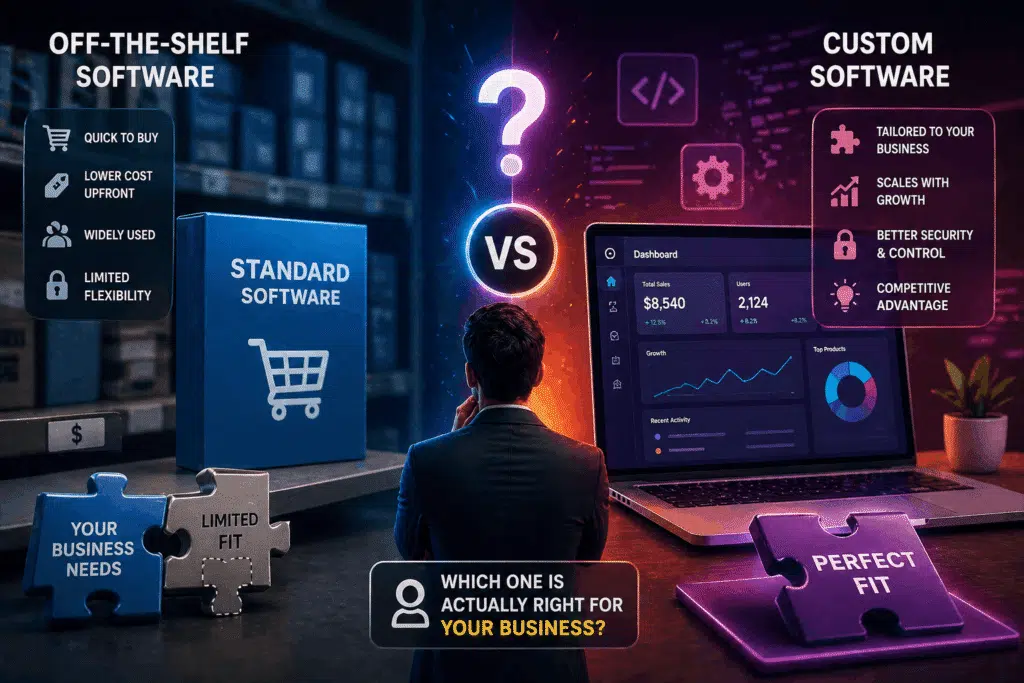
⚡ Key Takeaways
- Off-the-shelf software makes you adapt to it — custom software adapts to you. The right choice depends on your business stage and workflows.
- The true cost of off-the-shelf software over 3–5 years is almost always higher than businesses realise — subscriptions, per-user fees, and workaround costs compound fast.
- Custom software is not always the answer — if your processes are standard or still evolving, off-the-shelf is faster and more sensible.
- The most dangerous mistake is choosing a poor development partner — custom software is only as good as the team that builds it.
- A hybrid approach — off-the-shelf for standard functions, custom for unique workflows — is the most practical path for most growing Indian SMEs.
Your business has grown. The spreadsheets that worked fine two years ago are now causing errors, delays, and late-night headaches. You’re using three different software tools that don’t talk to each other, and your team is spending hours manually copying data between them. Or your off-the-shelf CRM has 400 features you don’t use and is missing the 3 that your business actually needs.
At some point, almost every growing business in India reaches this moment — the moment when the question shifts from “what software should I buy?” to “should I be building something specifically for us?”
This is one of the most consequential technology decisions a business can make. Choose the wrong path and you’re either locked into a generic tool that constrains your growth, or you’ve invested heavily in a custom solution that took too long, cost too much, and didn’t deliver what you expected.
The right software decision isn’t about which option is generally better. It’s about which option is right for your business, at your stage, with your specific workflows and growth trajectory.
This guide gives you the framework to make that decision with confidence — covering the real costs, the real benefits, and the real limitations of both off-the-shelf and custom software development for small business.
1. The Software Decision Every Growing Business Eventually Faces
There are two fundamentally different approaches to business software. The first is to use tools that already exist — products built for a broad market that your business adapts to. The second is to build tools specifically for your business — software that adapts to you, not the other way around.
Off-the-shelf software (also called COTS — Commercial Off-The-Shelf) includes the tools most businesses start with: Tally for accounting, Zoho or Salesforce for CRM, QuickBooks for finance, WordPress for website management, WhatsApp Business for customer communication. These products are built by software companies, sold to thousands or millions of businesses, and updated continuously by large development teams.
Custom software is built from scratch — or built as a significant extension of an existing platform — specifically for your business’s unique processes, workflows, data structures, and user requirements. It does exactly what you need, because you defined what it needs to do.
Neither approach is universally better. The right choice depends on where your business is today, where you’re going, and what your workflows actually require. Let’s examine both honestly.
2. What Is Off-the-Shelf Software? Strengths and Limitations
✅ The Genuine Strengths
Immediate availability: You can subscribe, onboard, and start using off-the-shelf software within hours or days. There is no development time, no waiting, no uncertainty about whether the product will work.
Lower upfront cost: Most off-the-shelf software is priced as a monthly subscription — ₹500 to ₹10,000 per month for most SME-focused tools. The upfront financial commitment is low compared to custom development.
Proven functionality: Popular off-the-shelf products have been tested by thousands of businesses across multiple industries. The core functionality works. Bugs are identified and fixed by dedicated engineering teams. You are not a beta tester.
Ongoing updates and support: Software vendors continuously improve their products, add features, and maintain security. You benefit from improvements without paying for them individually.
Community and integrations: Popular tools like Zoho, Salesforce, and QuickBooks have large user communities, extensive documentation, third-party integrations, and readily available support — both from the vendor and from independent consultants.
❌ The Real Limitations
You adapt to the software, not the reverse: Off-the-shelf software is designed for the average business in your category — not your specific business with its specific workflows. You will change how you work to fit the software, not the other way around. For simple, standard processes, this is fine. For complex, unique, or highly differentiated business processes, this compromise can be significant.
Feature bloat and missing critical functions: Most off-the-shelf tools offer far more features than any individual business needs — and often lack the specific feature that matters most to yours. You pay for 200 features you don’t use while working around the absence of 3 that you do.
Subscription costs compound over time: A ₹3,000/month subscription seems modest — until you’re paying ₹36,000/year for a tool that moderately fits your needs, plus ₹20,000/year for another tool to cover its gaps, plus integration costs. Many businesses spend more on off-the-shelf subscriptions over five years than a custom solution would have cost.
Data is on their servers, by their rules: Your business data lives in the vendor’s infrastructure, subject to their pricing, their data policies, and their business continuity. If the vendor raises prices, changes the product, or shuts down — your business is affected.
3. What Is Custom Software Development? Strengths and Limitations
✅ The Genuine Strengths
Built exactly for your workflows: Custom software is designed around how your business actually operates — not how a software vendor thinks businesses in your category generally operate. Every feature exists because you needed it. No feature is missing because a vendor didn’t prioritise it.
Competitive differentiation: Your competitors are using the same off-the-shelf tools you are. Custom software gives you capabilities they don’t have — faster processes, better data insights, unique customer experiences, or operational efficiencies that are genuinely proprietary.
Scales with your business: Good custom software is built to scale. As your business grows — more users, more transactions, more complexity — the software grows with you, without the per-user pricing escalations that make off-the-shelf tools prohibitively expensive at scale.
Complete data ownership: Your data lives on infrastructure you control, under your terms. No vendor lock-in. No risk of losing access because of a pricing dispute or a vendor going out of business.
Integration on your terms: Custom software can be built to integrate with your existing tools exactly as you need — not limited by what integrations a vendor has chosen to support in their marketplace.
❌ The Real Limitations
Higher upfront investment: Quality custom software development for small business requires a meaningful upfront investment — typically ₹3,00,000 to ₹15,00,000+ depending on complexity. This is not a monthly subscription. It is a capital investment.
Development time: Custom software takes time to build — typically 3 to 9 months for a complete business application, depending on scope. You cannot use it immediately.
Quality depends entirely on your development partner: Off-the-shelf software from an established vendor is a known quantity. Custom software is only as good as the team that builds it. A poor development partner delivers code that is slow, buggy, unmaintainable, and ultimately more expensive to fix than it was to build.
Ongoing maintenance responsibility: Unlike off-the-shelf software where the vendor handles updates and security patches, custom software requires ongoing maintenance from a development team. This is an ongoing cost that must be budgeted for.
4. The True Cost Comparison — What Most Businesses Get Wrong
Most businesses compare the upfront cost of custom development against the monthly cost of off-the-shelf software — and conclude that off-the-shelf is cheaper. This comparison is almost always wrong because it ignores the total cost of ownership over 3–5 years.
| Cost Factor | ❌ Off-the-Shelf (Hidden Costs) | ✅ Custom Software (Real Economics) |
|---|---|---|
| Initial Cost | Low (₹500–₹10,000/month) | One-time investment (₹3L–₹15L+) |
| Annual Subscription Growth | 10–20% price increase per year | ₹0 — no subscriptions |
| Per-User Fees at Scale | Escalates sharply as team grows | ₹0 — unlimited users |
| Integration Costs | Multiple tools, multiple subscriptions | Built-in from day one |
| Productivity Loss | Workarounds, manual data bridging | Minimal — fits your workflow exactly |
| 5-Year Total (15-user business) | ₹3,60,000 – ₹8,00,000+ | ₹4,00,000 – ₹6,00,000 (one-time) |
For a business currently spending ₹50,000–₹80,000 per year on multiple software subscriptions that only partially meet its needs, a ₹4,00,000 custom solution pays for itself in under 5 years — and delivers compounding competitive advantage every year after that.
5. Five Clear Signs Your Business Has Outgrown Off-the-Shelf Software
- Your team maintains parallel spreadsheets alongside the software. If people are keeping their own Excel sheets to compensate for what the software doesn’t do — the software isn’t working for your business.
- You’re paying for multiple tools to do what one should do. Three SaaS subscriptions for processes that should be connected is a classic sign of off-the-shelf patchwork.
- Your workflows have been changed to fit the software rather than the reverse. When your team says “we do it this way because of the software” — that’s the software dictating your business processes.
- You’re hitting user limits, storage limits, or feature walls at growth inflection points. The pricing tier that worked at 10 employees becomes prohibitive at 50.
- You have a unique business process that no off-the-shelf tool serves well. If you’ve evaluated six tools and none of them really fits — the problem isn’t the tools. It’s that your process is genuinely unique and needs bespoke software.
6. Five Situations Where Off-the-Shelf Is Absolutely the Right Choice
- You’re early stage with standard processes. If your business does what thousands of other businesses do, in a standard way, off-the-shelf tools are almost certainly sufficient and far more efficient than custom development.
- You need to move fast. A new business that needs accounting, CRM, and project management today cannot wait 6 months for custom development. Off-the-shelf gets you operational immediately.
- The category has excellent purpose-built tools. For accounting (Tally, Zoho Books), for email marketing (Mailchimp, Klaviyo), for HR (Keka, Darwinbox) — these products are excellent and would be foolish to replicate from scratch.
- Your budget cannot support custom development yet. If a ₹5,00,000 software investment is not feasible right now, use the best off-the-shelf option available and revisit custom development when your scale justifies the investment.
- Your processes are still evolving. Building custom software around processes that are still being defined is expensive and wasteful. Stabilise your workflows with off-the-shelf tools first, then build custom software around proven, stable processes.
7. The Middle Path: Custom Integrations and Hybrid Solutions
Not every business faces a binary choice between fully off-the-shelf and fully custom. There is a powerful middle path that many growing businesses in India use effectively: custom integrations and hybrid solutions.
This approach uses the best available off-the-shelf tools for standard functions — accounting, email, project management — and builds custom software specifically for the unique, differentiating parts of your business. The custom elements then integrate with your off-the-shelf tools, creating a unified system that is neither fully generic nor fully custom.
💡 Examples of Hybrid Solutions That Work Well for Indian SMEs
- A Goa hotel using standard property management software but with a custom booking portal that matches its brand and collects specific guest preference data
- A Mumbai retail business using Tally for accounting but with a custom inventory management system that tracks their specific product variants and vendor relationships
- A professional services firm using Zoho CRM but with a custom client portal that allows clients to access project updates, invoices, and deliverables in a branded environment
8. How to Choose a Custom Software Development Partner in India
The quality of your custom software development for small business partner is the single most important variable in the success of your project. Here’s how to evaluate your options:
🔍 They Understand Your Business Before They Write Code
A good development partner spends significant time in the discovery phase — understanding your workflows, your data, your users, and your growth plans — before proposing a technical solution. Be wary of developers who jump straight to technology choices without first deeply understanding what the software needs to accomplish.
📂 Portfolio of Delivered, Working Applications
Ask to see applications they have built — not mockups or screenshots, but live applications being actively used by real businesses. Ask to speak with past clients. Understand how the project was delivered: on time, on budget, and to scope?
📄 Clear Specification and Agreement Process
A professional development partner produces a detailed functional specification — a document that describes exactly what the software will do, how each feature will work, what the user interface will look like, and how the system will handle edge cases. This document becomes the contract. Any partner who starts coding without a detailed specification is setting up for expensive misalignments later.
🔧 Post-Launch Support and Maintenance
Software needs ongoing support — bug fixes, performance optimisation, security updates, and feature additions as your business evolves. A development partner who disappears after launch leaves you with unmaintained software that degrades over time. Look for partners who offer structured AMC agreements for your software.
🤝 Local Presence and Long-Term Partnership
For businesses in Goa and Mumbai, working with a local partner — like Cosmic Solutions — offers practical advantages: face-to-face requirements gathering, faster communication, cultural alignment, and a team that is invested in your local market’s success. We are not just a development vendor. We are a technology partner for the long term.
9. Frequently Asked Questions
Q1. How long does custom software development take for a small business in India?
Q2. What is the minimum budget for custom software development in India?
Q3. Can custom software integrate with the tools we already use?
Q4. How do I know if my business is ready for custom software?
Q5. What makes Cosmic Solutions different as a custom software development partner?
Conclusion
The decision between off-the-shelf and custom software development for small business is not about which option sounds more impressive. It is about understanding your business’s specific needs, growth trajectory, and the real total cost of each option over time.
Use off-the-shelf software when your needs are standard, your budget is limited, or your processes are still evolving. Invest in custom software when your workflows are unique, your off-the-shelf tools are limiting your growth, or when proprietary software capability would give you a genuine competitive advantage.
And when you’re ready to explore custom software development — whether for a focused web application development project, a complete business management system, or a custom integration between your existing tools — Cosmic Solutions has the expertise, the process, and the track record to deliver software that genuinely transforms how your business operates.
📞 Ready to Explore Custom Software for Your Business?
Get a free discovery consultation with Cosmic Solutions — we’ll help you determine whether custom software is the right next step, and what it would look like for your specific business.