 Cosmic Solutions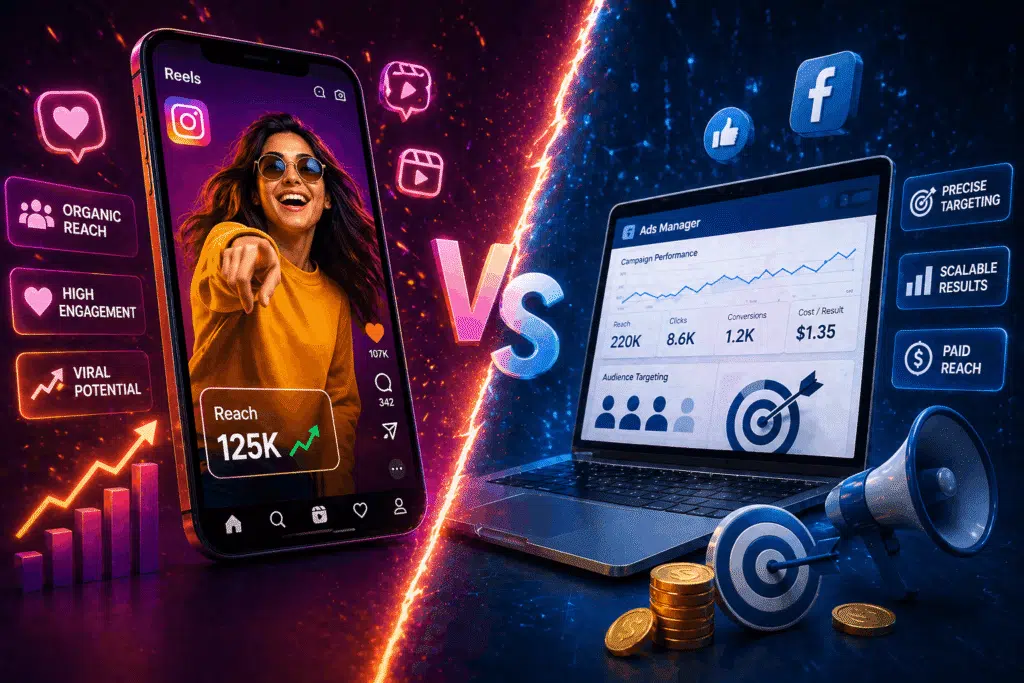
⚡ Key Takeaways
- Instagram Reels builds your audience organically — Facebook Ads targets a defined audience with precision. They do fundamentally different things.
- Reels are free to publish but require consistent, high-quality video content — results compound over 3–6 months, not overnight.
- Facebook Ads require budget (₹10,000–₹20,000/month to start) but can generate leads within days of a well-structured campaign launch.
- The most effective strategy for Indian small businesses uses both — Reels warm up the audience, Facebook Ads convert them.
- Businesses using Reels + retargeted Facebook Ads consistently see higher conversion rates than those using either platform alone.
Every small business owner in India with a phone and an Instagram account has asked this question at some point: “Should I be making Reels, or should I just run Facebook Ads?”
It’s a fair question — and an important one. Your time and money are finite. Social media feels overwhelming when you’re also running a business, serving customers, managing a team, and handling operations. The last thing you need is to spend hours creating content that generates zero business, or pour money into ads that produce clicks but no customers.
The good news is that the answer to this question is clearer than most people think. Instagram Reels and Facebook Ads are fundamentally different tools that do fundamentally different things. Understanding which one is right for your business — and when to use both together — is one of the most valuable things a small business owner can learn about social media marketing for small business in India.
Instagram Reels builds an audience. Facebook Ads targets one. The businesses winning on social media in India are using both — in the right order, for the right objectives.
This guide gives you the complete picture — no jargon, no fluff, and no generic advice that doesn’t account for the realities of running a small business in India in 2025.
1. Why This Question Matters More Than Ever for Indian Small Businesses
India now has over 500 million active social media users — the second largest social media market in the world. Instagram alone has over 350 million users in India, with the platform’s Reels feature driving more engagement than any other content format in the country. Facebook, while often described as a platform for older users, remains dominant among India’s 30–55 age group — which includes a significant proportion of business decision-makers, homeowners, and higher-income consumers.
For small businesses in India — whether you’re a boutique hotel in Goa, a professional services firm in Mumbai, a retail shop in Bangalore, or a startup anywhere — social media is no longer optional. Your customers are on these platforms, spending an average of 2.5–3 hours per day. The question is whether your business is showing up in front of them, and whether it’s showing up in a way that generates real business outcomes.
The stakes of getting this wrong are significant. A business that invests time in the wrong content format, or spends money on poorly structured ads, doesn’t just waste resources — it falls further behind competitors who are getting it right. The gap between businesses that use social media marketing for small business in India well and those that use it poorly is growing every year.
2. Understanding What Instagram Reels Actually Is — And What It Isn’t
Instagram Reels are short-form vertical videos — between 15 seconds and 3 minutes — published on Instagram. They are the platform’s primary growth tool, receiving dramatically more organic reach than static posts or Stories.
📈 What Makes Reels Powerful
The most important thing to understand about Reels is that they are an organic reach tool — meaning Instagram distributes them not just to your existing followers, but to non-followers who the algorithm believes will be interested in your content. This makes Reels one of the only remaining ways to reach a large audience on Instagram without paying for advertising.
A well-crafted Reel from a small business in Goa or Mumbai can reach tens of thousands of people — potential customers who had never heard of the business before — at zero cost. This is the fundamental promise of Reels: audience growth and brand awareness without ad spend.
⚠️ What Reels Cannot Do Reliably
Reels are not a reliable direct response tool. You cannot consistently target a specific audience with Reels the way you can with paid ads. You cannot guarantee that the people who see your Reel are in your target geography, income bracket, or buying stage. A Reel that goes viral among teenagers is useless if your business sells B2B software to company directors.
Reels also require consistent, high-quality video content — which takes time, creativity, and often equipment. A business that publishes one mediocre Reel and expects leads is misunderstanding what the format demands.
✅ Who Benefits Most From Reels
Businesses with visual products or services, lifestyle appeal, behind-the-scenes content, or educational expertise. Hospitality, food and beverage, fashion, beauty, fitness, real estate, and professional services with a human story to tell all perform exceptionally well with Reels. For these businesses, consistent Reels can build a meaningful, engaged audience over 3–6 months that becomes a powerful lead generation asset.
3. Understanding What Facebook Ads Actually Is — And What It Isn’t
Facebook Ads — which also includes Instagram Ads since both are managed through Meta’s Ads Manager — is a paid advertising platform that allows businesses to pay to show content to a precisely defined audience. This is fundamentally different from Reels: you are not earning reach organically. You are buying it — and the advantage of buying it is that you control exactly who sees your content.
🎯 What Makes Facebook Ads Powerful
The targeting capabilities of Meta’s advertising platform are extraordinary. You can reach people based on location (down to a specific city or even radius), age, gender, interests, behaviours, income indicators, life events, and job title. You can target people who have visited your website, watched your videos, engaged with your Instagram profile, or match the characteristics of your existing customers.
For social media marketing for small business in India, this targeting precision means you can put your business in front of exactly the right people — not a random audience, not a teenage Reel viewer who has no interest in your B2B service, but the specific profile of customer you actually want to attract.
⚠️ What Facebook Ads Cannot Do
Facebook Ads cannot build organic credibility or community the way Reels can. An ad is always identifiable as an ad — and Indian consumers, increasingly ad-literate, treat ads with appropriate scepticism. An ad that isn’t backed by a credible social profile, good reviews, and authentic content often underperforms because the trust foundation isn’t there.
Facebook Ads also require budget — and budget management skill. A poorly structured campaign with bad targeting, weak creative, or no conversion tracking burns money with nothing to show for it. This is why many small business owners in India have had disappointing experiences with Facebook Ads — not because the platform doesn’t work, but because running it effectively requires expertise.
✅ Who Benefits Most From Facebook Ads
Businesses with a clearly defined target audience, a specific offer or conversion goal, and a website or landing page that can capture leads. Professional services, B2B companies, real estate, education, healthcare, and any business targeting a specific geographic area or demographic profile can see exceptional results from well-managed Facebook Ads.
4. Head-to-Head Comparison: Reach, Cost, Intent & Conversion
| Factor | 📱 Instagram Reels | 🎯 Facebook Ads |
|---|---|---|
| Reach | Potentially massive organic reach to non-followers. Unpredictable but scalable with no additional cost per view. | Controlled, guaranteed reach to a defined audience. Reach scales directly with budget. |
| Cost | Free to publish. Cost is your time and content production — no direct monetary spend required. | Requires budget. CPM in India typically ₹50–₹300. Cost per lead ranges ₹50 (broad consumer) to ₹1,000+ (niche B2B). |
| Audience Precision | Low control. Algorithm decides who sees your content. Influenced by hashtags and content relevance — not guaranteed. | Very high control. Define exactly who sees your ad — location, demographics, interests, behaviours, custom and lookalike audiences. |
| Buying Intent | Low direct purchase intent. Users are in discovery and entertainment mode — Reels build awareness and desire, not immediate conversion. | Variable. Retargeting warm audiences (website visitors, video viewers) carries high intent. Cold audience awareness ads carry lower intent. |
| Speed to Results | Slow burn. Consistent Reels build compounding audience growth over 3–6 months. Individual viral Reels can spike quickly but are unpredictable. | Fast. A well-set-up campaign can generate leads within days of launch. |
5. Which Industries in India Benefit More From Reels vs Facebook Ads?
| 📱 Reels-First Industries | 🎯 Facebook Ads-First Industries | ⚡ Both Equally — The Sweet Spot |
|---|---|---|
| Hospitality & Tourism (Goa, Rajasthan, Kerala) — Visual destinations sell themselves through Reels | Professional Services (Legal, Financial, HR) — Precision targeting by job title and income matters more than visual appeal | Most small businesses in Goa and Mumbai fall here — they have visual appeal that suits Reels AND a defined audience that benefits from paid targeting.
A web design agency, a hotel, a catering company, a boutique retail brand — all can use Reels to build credibility and audience, and Facebook Ads to reach specific decision-makers with specific offers. |
| Food & Beverage — Recipe content, restaurant ambience, chef behind-the-scenes | B2B Services (IT, Software, Digital Marketing) — Decision-makers need to be reached precisely | |
| Fashion & Retail — Product showcases, styling tips, unboxing | Healthcare & Education — Audience-specific targeting ensures the right message reaches the right demographic | |
| Fitness & Wellness — Workout demos, transformation stories, expert tips | Real Estate (Premium) — High-value buyers targeted by income and location | |
| Interior Design & Real Estate — Before-and-after transformations, property tours | Event Promotion — Time-sensitive offers need paid reach, not organic discovery |
6. The Real Answer: Why It’s Not Either/Or
Here’s the truth that most comparison articles don’t tell you: the question itself is a false dichotomy. The most effective social media marketing for small business in India strategy in 2025 doesn’t choose between Reels and Facebook Ads. It uses both — at different stages of the customer journey, for different objectives, in a way that makes each more powerful than it would be alone.
Reels warm up your audience. Facebook Ads convert them. Together, they create a social media ecosystem where organic content builds trust and paid content closes the deal.
Here’s how this works in practice. Your Reels build organic reach and credibility — potential customers discover your brand, watch your content, follow your profile, and begin to trust you. Your Facebook Ads then retarget these warm audiences — people who’ve already watched your Reels, visited your website, or engaged with your profile — with specific offers and calls to action. Because these audiences already know and trust your brand from your organic content, they convert at dramatically higher rates than cold audiences seeing your ad for the first time.
This combination — organic content building the audience, paid ads converting it — is the engine behind the social media success of the best-performing small businesses across India. And it is exactly the integrated approach that Cosmic Solutions builds and manages for its clients.
7. How to Build a Social Media Strategy That Uses Both Effectively
Step 1: 🏗️ Establish Your Organic Presence First
Before spending a single rupee on ads, build a credible, active social profile. Publish Reels consistently — aim for 3–4 per week minimum. Use your business’s authentic voice, real imagery, and genuinely useful content. Build a following that represents a real, engaged audience before you try to convert them.
Step 2: 📊 Identify Your Best-Performing Content
After 4–8 weeks of consistent posting, you’ll have data. Which Reels got the most views, saves, and comments? Which content generated DMs or profile visits? These top-performing pieces of organic content are your best candidates for paid amplification — you already know they resonate with your audience.
Step 3: 🎯 Amplify With Paid — Starting With Warm Audiences
Your first Facebook/Instagram Ad campaigns should target people who already know you — website visitors, Instagram profile visitors, video viewers, and email list. These warm retargeting campaigns consistently deliver the best ROI for small businesses because the trust foundation is already in place.
Step 4: 🚀 Expand to Cold Audiences With Proven Creative
Once you know which ad creative and offer converts your warm audience, use that proven combination to reach cold audiences — new potential customers who match the profile of your best existing customers. This is where Meta Lookalike Audiences become powerful: targeting people who share characteristics with your website visitors, your Instagram followers, or your customer list.
Step 5: 📈 Measure, Optimise, and Reinvest
Track your cost per lead, your conversion rate, and your return on ad spend. Double down on what works. Stop what doesn’t. Reinvest savings from efficient campaigns into more content production and higher ad budgets. This compounding cycle is how small businesses build sustainable social media momentum.
8. Common Mistakes Indian Small Businesses Make on Social Media
| ❌ Common Mistake | ✅ What to Do Instead |
|---|---|
| Boosting posts instead of running structured campaigns — the Boost button is Meta’s least effective ad product | Always use Ads Manager for proper campaign structure, targeting, and optimisation |
| Posting inconsistently — three Reels one week, nothing for three weeks | Consistency beats frequency. A steady 3 Reels/week for 12 weeks beats 10 Reels in week one and silence after |
| Using stock images and generic content — Indian consumers can spot inauthentic content instantly | Use real photography and real stories. Authentic content outperforms stock every time |
| No clear call to action — content ends without telling the viewer what to do next | Every post and every ad must tell viewers exactly what to do — DM us, click the link, call now, visit the website |
| Running ads without a good landing page — sending ad traffic to a slow or cluttered website | Build a dedicated, fast-loading landing page for each campaign before spending on ads |
| No tracking or measurement — spending without knowing what’s actually working | Set up Meta Pixel, track conversions, and measure what connects to actual business outcomes |
| Chasing vanity metrics — likes and followers feel good but don’t pay bills | Focus on metrics that matter: enquiries, website visits, leads, and sales |
9. Frequently Asked Questions
Q1. How much should a small business in India spend on Facebook Ads to start seeing results?
Q2. How often should I post Reels for my business?
Q3. Does Instagram Reels work for B2B businesses?
Q4. Should I use Instagram or Facebook for ads — they’re both Meta, right?
Q5. Can Cosmic Solutions manage both our Reels content and our Facebook Ads?
Conclusion
The Instagram Reels vs Facebook Ads debate is ultimately a false choice. Both are valuable. Both serve different and complementary roles in a complete social media marketing for small business in India strategy. Reels build your audience organically, establish your credibility, and warm up potential customers. Facebook Ads convert those warm audiences with precision and scale. Together, they create a social media engine that grows more powerful over time — compounding your investment in content and paid reach into a consistent, predictable source of business growth.
The businesses in Goa and across India that are growing fastest on social media are not the ones with the biggest budgets. They are the ones with the clearest strategy, the most consistent execution, and the right partner helping them integrate every element into a system that actually works.
Cosmic Solutions provides complete Social Media Marketing for businesses across Goa and Mumbai — organic Reels strategy, Meta Ads campaign management, analytics, and continuous optimisation. We are your complete digital marketing agency in Goa — one accountable partner for everything social.
📞 Ready to Build a Social Media Strategy That Generates Real Results?
Get a free social media audit and a customised strategy recommendation for your business — no obligation, no jargon.